
In the intricate tapestry of modern business, the concept of resource allocation emerges as a critical thread, weaving together the diverse elements of organizational strategy, operational efficiency, and sustainable growth. As we delve into the nuances of this multifaceted topic, we uncover a realm where the judicious distribution of resources can make the difference between a company's success and its stagnation. Through a meticulous examination of the principles, processes, and real-world applications of resource allocation, we aim to provide a comprehensive understanding of how businesses can navigate the labyrinth of operational efficiency and emerge victorious.
Understanding the Essence of Resource Allocation
At its core, resource allocation refers to the strategic process of assigning available resources—financial, human, material, or otherwise—to various projects, departments, or initiatives within an organization. It is a fundamental decision-making exercise that permeates every aspect of business operations, from the allocation of marketing budgets to the distribution of human capital. The primary objective of effective resource allocation is to optimize the utilization of resources, ensuring that each unit is invested in a manner that aligns with the company's overarching goals and maximizes output, profitability, and efficiency.
The significance of resource allocation in the business world cannot be overstated. It serves as the bedrock upon which organizations build their operational frameworks, enabling them to respond nimbly to the ever-shifting dynamics of the market and the competitive landscape. Moreover, in an era where sustainability and corporate responsibility have become paramount, the way a company allocates its resources can also reflect its commitment to these crucial values.
The Scope of Resource Allocation
It is essential to recognize that resource allocation extends far beyond the mere apportionment of financial assets. It encompasses the strategic distribution of:
Human resources: Assigning the right talent to the right tasks and projects.
Equipment and technology: Ensuring that the necessary tools and infrastructure are available to support operations.
Physical space: Optimizing the utilization of office spaces, manufacturing facilities, and other physical assets.
Intangible resources: Allocating resources such as time, knowledge, and intellectual property.
The scope of resource allocation is all-encompassing, demanding a delicate balance between the immediate needs and the long-term aspirations of the organization. It requires a holistic approach that takes into account the interdependencies and synergies among different resources, fostering an environment where every asset is leveraged to its fullest potential without redundancy or waste.
Principles of Effective Resource Allocation
To ensure that resource allocation yields the desired outcomes, organizations must adhere to a set of guiding principles. These principles serve as the foundation upon which effective resource allocation strategies are built, providing a framework for decision-making and prioritization.
Alignment with Strategic Objectives
One of the cardinal principles of resource allocation is alignment with the strategic objectives of the organization. Every resource, whether financial, human, or material, should be allocated in a manner that supports the company's overarching goals and vision. This alignment ensures that all efforts are directed towards a common purpose, creating a cohesive narrative for the organization's journey towards success.
Real-life examples abound that demonstrate the power of aligning resource allocation with strategic objectives. Consider the case of Google, a tech giant renowned for its innovative prowess. Google's decision to allocate substantial resources to projects like Google Cloud and artificial intelligence research aligns perfectly with its strategic goal of being the leading data-driven technology company. By investing in these areas, Google not only consolidates its market position but also opens up new avenues for growth and revenue generation.
Similarly, Apple Inc. serves as another compelling example of the principle of alignment. The company consistently allocates significant resources to research and development, ensuring that its products remain at the forefront of innovation and design. This unwavering commitment to R&D aligns seamlessly with Apple's strategic objective of delivering cutting-edge, user-centric devices that redefine the market and captivate consumers.
Balancing Risk and Reward
Another crucial principle of resource allocation is the balance between risk and reward. Organizations must carefully assess the potential gains and losses associated with each resource allocation decision, ensuring that the expected returns justify the investments made. This principle is particularly relevant in high-stakes scenarios, where the allocation of resources can have a profound impact on the company's bottom line and competitive position.
The pharmaceutical industry provides a striking illustration of the balance between risk and reward in resource allocation. Companies like Pfizer and AstraZeneca routinely invest billions of dollars in the development of new drugs, knowing full well that the process is fraught with uncertainty and the possibility of failure. However, the potential rewards—both in terms of financial gains and societal impact—can be immense if a groundbreaking medication is successfully developed and brought to market.
Venture capital firms also embody the principle of balancing risk and reward in their resource allocation strategies. These firms distribute their resources across a diverse portfolio of startups, carefully calibrating the mix of high-risk, high-potential ventures and more stable, established companies. By strategically allocating their resources in this manner, venture capitalists aim to maximize their returns while mitigating the overall risk exposure.
Timing and Agility
The timing of resource allocation is a critical factor that often goes overlooked. The impact of an allocated resource can vary significantly depending on the stage of the project, the market conditions, or the competitive landscape. Organizations must be attuned to the temporal dimensions of resource allocation, ensuring that resources are deployed at the most opportune moments to maximize their effectiveness.
Moreover, in today's rapidly evolving business environment, agility in resource allocation has become a key differentiator. Companies that can swiftly adapt their resource allocation strategies in response to changing circumstances are better positioned to seize opportunities and mitigate risks. This agility requires a flexible and responsive approach to resource management, coupled with robust decision-making frameworks that enable quick and informed adjustments.
Fairness and Objectivity
Promoting fairness and objectivity in the resource allocation process is essential for fostering a positive organizational culture and ensuring the optimal utilization of resources. Decisions regarding resource allocation should be based on merit, data-driven insights, and the potential for value creation, rather than personal biases or political considerations.
Balancing Capacity Responsiveness Flexibility And Cost İn Supply Chain
İmprove Operations With Overall Equipment Effectiveness İnsights
When resource allocation is perceived as fair and objective, it can have a profound impact on employee morale, engagement, and productivity. It sends a clear message that the organization values transparency, accountability, and the equitable treatment of all stakeholders. Conversely, when resource allocation is seen as biased or arbitrary, it can breed resentment, demotivation, and a lack of trust in leadership.
The Process of Resource Allocation
With the guiding principles of resource allocation in mind, let us now delve into the actual process of allocating resources effectively. This process involves a series of interconnected steps, each of which plays a crucial role in ensuring that resources are deployed in a manner that maximizes value and aligns with the organization's strategic objectives.
Setting Clear Objectives
The first step in the resource allocation process is to set clear, measurable objectives that define the desired outcomes. These objectives should be specific, time-bound, and aligned with the overall strategic goals of the organization. Without a well-defined set of objectives, resource allocation can become haphazard and inefficient, leading to suboptimal results and wasted resources.
Practical examples of setting clear objectives for resource allocation abound across various industries. Consider the case of a product launch campaign in the technology sector. Companies like Tesla set precise targets for pre-orders, production numbers, and revenue, which guide their allocation of marketing budgets, manufacturing resources, and workforce distribution. By having these clear objectives in place, Tesla can ensure that its resources are deployed in a focused and effective manner, maximizing the chances of a successful product launch.
Similarly, in the construction industry, clear objectives are essential for the efficient allocation of resources. These objectives may include specific timelines for project completion, budget adherence, and quality standards. By setting these objectives upfront, construction companies can effectively channel their resources—such as raw materials, labor, and capital—towards achieving the desired outcomes within the specified constraints.
Assessing Available Resources
Once the objectives are clearly defined, the next step is to conduct a thorough assessment of the available resources. This assessment involves a comprehensive analysis of the quantity, quality, and potential utility of the resources at the organization's disposal. By gaining a clear understanding of the resource landscape, businesses can identify gaps that need to be addressed, as well as opportunities for optimization and reallocation.
The assessment process should encompass all types of resources, including financial assets, human capital, technology infrastructure, physical assets, and intangible resources such as intellectual property and brand equity. It is essential to have a holistic view of the resource portfolio to make informed decisions about allocation and prioritization.
Determining the Best Use of Resources
With a clear understanding of the objectives and the available resources, the next step is to determine the best use of those resources. This involves a strategic decision-making process that takes into account a wide range of factors, including the current needs of the organization, future growth projections, competitive dynamics, and the potential return on investment.
Determining the optimal allocation of resources requires a deep understanding of the business landscape, as well as the ability to anticipate and adapt to changing circumstances. It involves a careful balancing act between short-term operational requirements and long-term strategic imperatives, ensuring that resources are deployed in a manner that maximizes value creation and minimizes waste.
Monitoring and Review
The resource allocation process does not end with the initial deployment of resources. It is an ongoing, iterative process that requires continuous monitoring and review to ensure that resources remain aligned with the evolving needs of the organization and that the desired outcomes are being achieved.
Regular monitoring allows for the early identification of any deviations from the planned allocation, enabling timely corrective actions to be taken. It also provides valuable insights into the effectiveness of the allocation strategies, highlighting areas for improvement and optimization.
Case studies from various industries highlight the importance of monitoring and review in resource allocation. For example, Toyota's renowned production system relies on a just-in-time inventory approach, which requires constant monitoring and adjustment to ensure that resources, such as automotive parts, are available exactly when needed. This meticulous monitoring enables Toyota to minimize waste, reduce inventory costs, and maintain a highly efficient production process.
Similarly, in the IT industry, companies like IBM regularly review their resource allocation strategies in light of their strategic priorities. As IBM shifts its focus towards emerging technologies such as cloud computing and artificial intelligence, it must continually reassess its R&D spending and resource allocation to ensure alignment with these strategic directions. This ongoing review process allows IBM to remain agile and responsive to the rapidly evolving technology landscape.
Challenges in Resource Allocation
While the principles and processes of resource allocation provide a solid foundation for effective decision-making, organizations often face a multitude of challenges when it comes to putting these concepts into practice. These challenges can arise from various factors, including the inherent limitations of resources, competing priorities, and the dynamic nature of the business environment.
Limited Resources vs. Unlimited Wants
One of the most fundamental challenges in resource allocation is the age-old economic dilemma of limited resources versus unlimited wants. Organizations, regardless of their size or industry, operate within the constraints of finite resources. Whether it is financial capital, human talent, or physical assets, there is always a limit to what is available.
On the other hand, the aspirations and ambitions of organizations are often boundless. Companies seek to expand into new markets, develop innovative products, and pursue growth opportunities, all of which require the allocation of resources. The challenge lies in striking a balance between these competing demands and ensuring that the limited resources are allocated in a manner that maximizes value and aligns with the strategic priorities.
Startups and small businesses, in particular, often grapple with the challenge of limited resources. Operating on tight budgets and with lean teams, these organizations must make difficult trade-offs and prioritize their resource allocation decisions. Success stories like Slack and Spotify demonstrate how strategic resource allocation, even in the face of constraints, can lead to remarkable growth and market disruption. These companies focused their limited resources on the core aspects of their business that had the greatest potential for value creation, while ruthlessly prioritizing and reallocating resources away from less critical areas.
Prioritizing Competing Needs
Another significant challenge in resource allocation is prioritizing competing needs and stakeholder interests. Within any organization, there are multiple departments, projects, and initiatives vying for resources. Each of these entities may have its own set of objectives, metrics, and stakeholders, making it difficult to determine which ones should take precedence in the allocation process.
For example, the marketing department may argue for increased budget allocation to support a new product launch, while the R&D team may advocate for additional resources to accelerate innovation efforts. Similarly, different business units may have conflicting resource requirements, with some focusing on short-term profitability while others prioritize long-term market share growth.
Navigating these competing needs requires a robust decision-making framework that takes into account the strategic objectives of the organization, the potential impact of each initiative, and the trade-offs involved. It also demands effective communication and collaboration among stakeholders to build consensus and alignment around resource allocation decisions.
Dynamic Business Environments
The challenge of resource allocation is further compounded by the dynamic nature of business environments. In today's fast-paced and ever-changing world, the factors that influence resource allocation decisions are in a constant state of flux. Market trends, technological advancements, regulatory changes, and shifts in consumer behavior can all have a significant impact on the optimal allocation of resources.
Organizations must be agile and adaptable in their resource allocation strategies to navigate these dynamic environments effectively. They need to be able to quickly reassess and adjust their resource deployment in response to new opportunities, threats, or changes in the competitive landscape.
The finance industry, for example, operates in a highly volatile and regulated environment. Hedge funds and other financial institutions must continually adapt their resource allocation strategies to navigate the complexities of the financial markets. They must be able to rapidly shift resources between different asset classes, geographies, and investment strategies based on real-time market data and risk assessments.
Similarly, companies like Amazon have demonstrated remarkable agility in their resource allocation approach. As the company has expanded beyond its core e-commerce business into areas such as cloud computing, artificial intelligence, and healthcare, it has continuously reallocated resources to support these strategic initiatives. By being flexible and adaptable in its resource allocation, Amazon has been able to capitalize on new growth opportunities and maintain its competitive edge in a rapidly evolving business landscape.
Strategies for Effective Resource Allocation
Given the challenges and complexities involved in resource allocation, organizations need to adopt a range of strategies to ensure that their resources are deployed in an effective and efficient manner. These strategies should be tailored to the specific needs and context of the organization, taking into account its strategic objectives, industry dynamics, and available resources.
Leveraging Technology and Tools
One key strategy for enhancing resource allocation outcomes is to leverage cutting-edge technology and tools. In today's digital age, there is a wide array of software solutions and analytical tools available that can provide organizations with deeper insights into their resource management practices.
Advanced project management software, for example, can help organizations optimize their resource allocation by providing real-time visibility into project progress, resource utilization, and potential bottlenecks. These tools can also facilitate collaboration and communication among team members, ensuring that resources are deployed in a coordinated and efficient manner.
Similarly, data analytics and business intelligence tools can provide organizations with valuable insights into their resource allocation patterns, identifying areas of inefficiency or underutilization. By leveraging these tools, organizations can make data-driven decisions about resource allocation, optimizing their resource deployment based on historical performance and predictive analytics.
Flexibility and Adaptability
Another critical strategy for effective resource allocation is to cultivate a culture of flexibility and adaptability within the organization. In a rapidly changing business environment, the ability to quickly pivot and reallocate resources in response to new challenges or opportunities can be a key differentiator.
This requires a mindset shift away from rigid, long-term resource allocation plans and towards a more agile and responsive approach. Organizations need to build flexibility into their resource allocation processes, allowing for the rapid redeployment of resources as circumstances change.
One way to foster flexibility is to adopt a more modular and decentralized approach to resource allocation. By empowering teams and business units with greater autonomy over their resource allocation decisions, organizations can enable faster and more localized responses to changing needs. This approach also promotes a sense of ownership and accountability among team members, encouraging them to be more proactive and innovative in their resource utilization.
Developing a Culture of Resource Stewardship
Effective resource allocation is not just about the mechanics of deploying resources; it is also about fostering a culture of resource stewardship throughout the organization. This means instilling a sense of responsibility and accountability for the efficient and effective use of resources at all levels of the organization.
Developing a culture of resource stewardship requires a multi-faceted approach. It involves setting clear expectations and guidelines for resource utilization, providing training and support to employees on best practices for resource management, and recognizing and rewarding individuals and teams who demonstrate exemplary resource stewardship.
It also involves promoting a mindset of continuous improvement and innovation in resource allocation. Encouraging employees to think creatively about how resources can be optimized, repurposed, or reallocated can lead to significant efficiency gains and cost savings over time.
The Future of Resource Allocation
As we look to the future, it is clear that the field of resource allocation is poised for significant transformation and advancement. Emerging trends and technologies are reshaping the way organizations approach resource management, opening up new possibilities for optimization and value creation.
Integration of Sustainability Considerations
One key trend that is likely to shape the future of resource allocation is the growing emphasis on sustainability and environmental responsibility. As concerns about climate change, resource depletion, and social impact continue to mount, organizations are increasingly integrating sustainability considerations into their resource allocation decisions.
This means looking beyond short-term financial metrics and considering the long-term environmental and social implications of resource deployment. It involves assessing the carbon footprint of different resource allocation options, prioritizing the use of renewable and sustainable resources, and considering the impact of resource utilization on local communities and ecosystems.
Integrating sustainability into resource allocation requires a fundamental shift in mindset and decision-making frameworks. It demands a more holistic and long-term perspective on value creation, recognizing that the true costs and benefits of resource allocation extend far beyond the immediate financial bottom line.
Complexity of Global Supply Chains
Another trend that is likely to shape the future of resource allocation is the growing complexity of global supply chains. As organizations become more interconnected and reliant on a web of suppliers, partners, and customers spread across the globe, the challenges of resource allocation become more intricate and multifaceted.
Managing resource allocation in the context of global supply chains requires a deep understanding of the interdependencies and risks involved. It necessitates sophisticated modeling and simulation tools to assess the impact of resource allocation decisions on the entire supply chain, taking into account factors such as lead times, inventory levels, and transportation costs.
It also requires a high degree of collaboration and coordination among supply chain partners to ensure that resources are allocated in a manner that optimizes overall performance and resilience. This may involve the development of shared resource pools, the establishment of common performance metrics, and the use of blockchain and other technologies to enable transparent and secure resource tracking and allocation.
The Role of Artificial Intelligence and Machine Learning
Perhaps the most transformative trend in the future of resource allocation is the growing role of artificial intelligence (AI) and machine learning (ML) in decision-making processes. These technologies have the potential to revolutionize the way organizations approach resource management, enabling more precise, data-driven, and adaptive allocation strategies.
AI and ML algorithms can analyze vast amounts of data on resource utilization, performance metrics, and external factors to identify patterns and insights that may not be apparent to human decision-makers. They can also learn from past allocation decisions and outcomes to continuously refine and optimize resource deployment over time.
For example, AI-powered predictive analytics can help organizations anticipate future resource needs based on historical data and market trends, enabling proactive resource planning and allocation. Machine learning algorithms can also be used to dynamically adjust resource allocation in real-time based on changing circumstances, such as fluctuations in demand or supply chain disruptions.
The integration of AI and ML into resource allocation processes has the potential to drive significant efficiency gains and cost savings, while also enabling organizations to respond more quickly and effectively to emerging opportunities and challenges.
Conclusion
The art and science of resource allocation is a critical determinant of organizational success in today's complex and rapidly evolving business landscape. As we have explored throughout this article, effective resource allocation requires a deep understanding of the principles, processes, and challenges involved, as well as a willingness to embrace new strategies and technologies.
From aligning resource deployment with strategic objectives to balancing risk and reward, the principles of resource allocation provide a foundation for effective decision-making. The process of resource allocation, encompassing objective setting, resource assessment, deployment, and monitoring, offers a structured approach to optimizing resource utilization.
However, the challenges of resource allocation, from the inherent limitations of resources to the complexities of dynamic business environments, underscore the need for ongoing adaptation and innovation in resource management practices.
As we look to the future, the integration of sustainability considerations, the growing complexity of global supply chains, and the transformative potential of AI and ML are all likely to shape the evolution of resource allocation in the years to come.
Ultimately, the organizations that will thrive in this new era of resource allocation will be those that can effectively navigate the labyrinth of operational efficiency, balancing short-term needs with long-term value creation. They will be the ones that can harness the power of data, technology, and human ingenuity to make smart, agile, and responsible resource allocation decisions in the face of ever-changing challenges and opportunities.
The art and science of resource allocation is not a destination, but a journey of continuous learning, adaptation, and improvement. As business leaders and decision-makers, it is our responsibility to embrace this journey with curiosity, courage, and a commitment to creating value for all stakeholders. Only then can we truly unlock the full potential of our organizations and contribute to a more sustainable and prosperous future for all.
Frequently Asked Questions
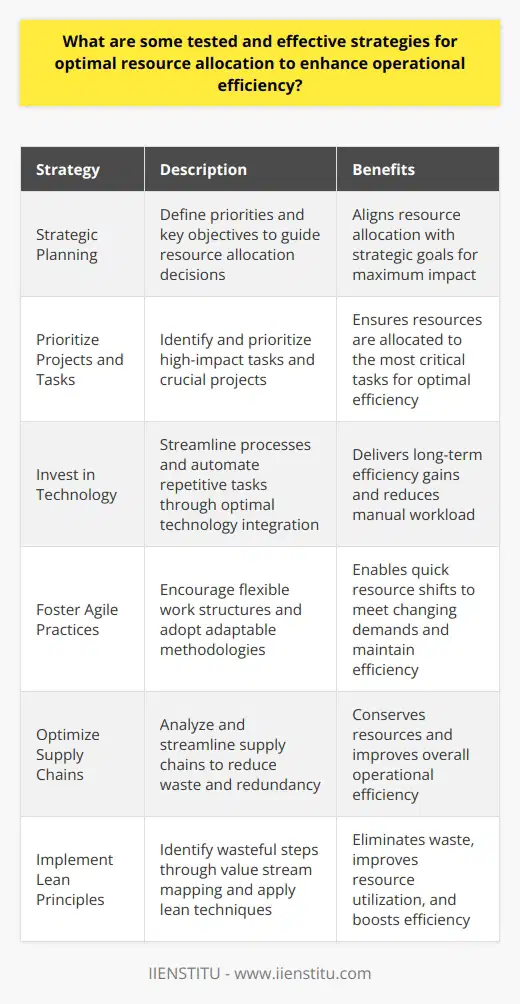
What are some tested and effective strategies for optimal resource allocation to enhance operational efficiency?
Understanding Resource Allocation
Resource allocation involves assigning available resources. These resources are financial, human, and material. They are essential to an organization's objectives. Effective resource allocation enhances operational efficiency. It aligns with strategic goals.
Begin with Strategic Planning
Strategic planning defines where resources go. It sets priorities. It points to key objectives. Strategy guides resource allocation decisions. Resources go where they make the biggest impact.
Prioritize Projects and Tasks
Not all tasks are equal.
- Identify high-impact tasks.
- Prioritize crucial projects.
These demand more resources. Lesser tasks can wait.
Regularly Review and Adapt
Efficiency demands adaptability. Markets and demands change. So should resource allocation. Regular reviews can signal these changes. Adaptation ensures continued efficiency.
Use Performance Metrics
Performance metrics give feedback.
- They measure efficiency and effectiveness.
- They confirm correct resource use.
Identify the right metrics. Track them consistently.
Invest in Technology
Technology can streamline processes. It automates repetitive tasks. Optimal technology integration requires resources. But it delivers long-term efficiency.
Foster Agile Practices
Agility responds to change fast.
- Encourage flexible work structures.
- Adopt adaptable methodologies.
Resources shift to where they're needed quickly.
Balance Short and Long-Term Goals
Immediate goals cannot consume all resources. Invest in future growth too. Balance is key. Allocate resources with a dual focus.
Encourage Cross-Functional Collaboration
Silos impede efficiency.
- Promote teamwork across departments.
- Break barriers to resource sharing.
Collaboration optimizes resource use enterprise-wide.
Train and Develop Human Capital
People propel an organization. Training enhances their productivity. Development maximizes resource allocation. Invest in your workforce's skills.
Monitor and Manage Risks
Risk can disrupt operations. Effective risk management protects resources. Assess and mitigate risks proactively. Secure your resource allocation against uncertainties.
Optimize Supply Chains
Supply chains are resource-heavy.
- Analyze and streamline supply chains.
- Reduce waste and redundancy.
An efficient supply chain conserves resources.
Utilize Capacity Planning Tools
Capacity planning tools match resources to workload. They prevent over or underutilization. Proper use of these tools ensures efficient operations.
Implement Lean Principles
Lean principles target waste elimination.
- Value stream mapping identifies wasteful steps.
- Lean techniques improve resource use.
Embrace lean thinking to boost efficiency.
Encourage Innovation
Innovation finds new ways to use resources.
- Empower employees to suggest improvements.
- Reward innovative resource allocation solutions.
Innovative cultures find efficiency gains continuously.
Through these strategies, an organization can optimize resource allocation. They enable more efficient and productive operations. The strategies require commitment but provide significant long-term benefits.
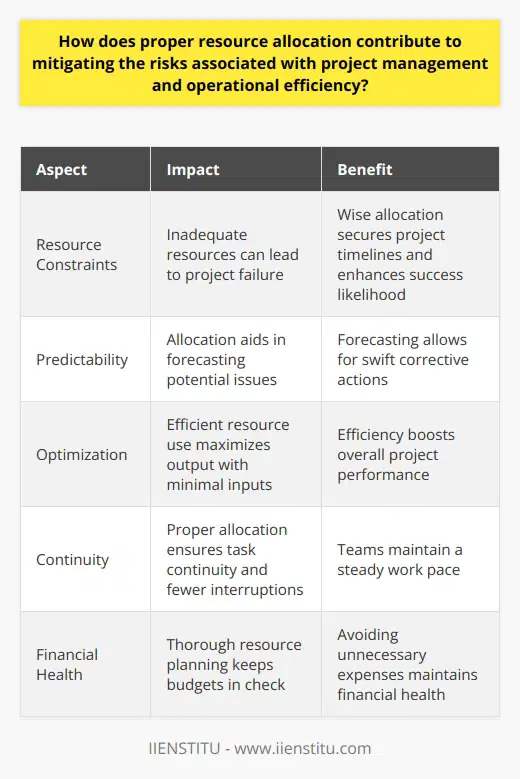
How does proper resource allocation contribute to mitigating the risks associated with project management and operational efficiency?
Importance of Resource Allocation
Proper resource allocation stands vital in project management. It assures a balanced distribution of assets. These assets may be time, money, or human skills. Effective allocation connects directly to risk mitigation. Allocating resources wisely prevents bottlenecks. It also ensures operational efficiency.
Risk Mitigation Through Allocation
Resource Constraints
Resource constraints pose significant risks. Not addressing these can lead to project failure. Wise resource allocation secures project timelines. It also enhances the likelihood of successful outcomes.
Predictability
Allocation boosts predictability in projects. It aids in forecasting potential issues. Forecasting allows for swift corrective actions.
Optimization
Efficient resource use optimizes the project flow. It maximizes output with minimal inputs. This efficiency boosts overall performance.
Operational Efficiency and Resource Allocation
Continuity
Proper allocation ensures task continuity. Interruptions are fewer. Teams thus maintain a steady work pace.
Morale
Adequate resources foster team confidence. They also improve morale. Confident teams often perform better.
Financial Health
Thorough resource planning keeps budgets in check. It avoids unnecessary expenses. The latter maintains financial health.
Conclusion
In sum, resource allocation holds the key. It tackles risks and fosters operational efficiency. Projects thus completed within scope, time, and budget reap success. Allocate effectively, and watch projects thrive.
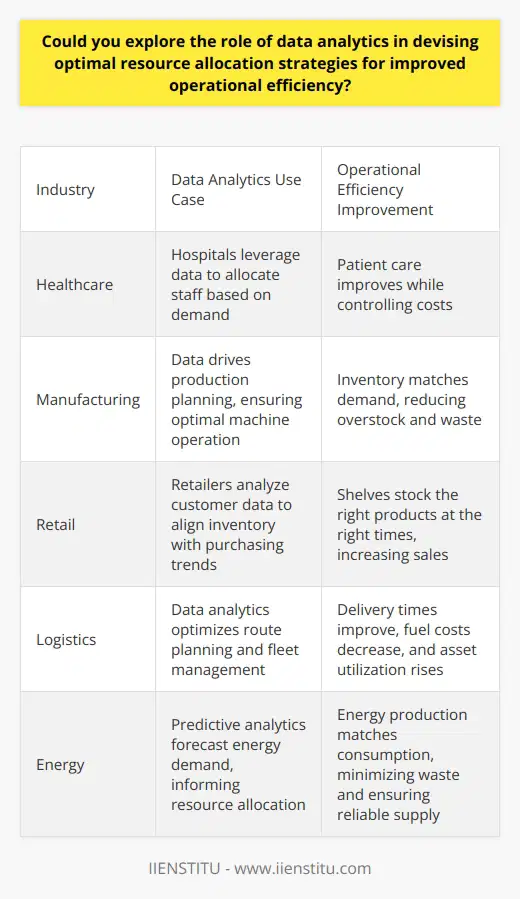
Could you explore the role of data analytics in devising optimal resource allocation strategies for improved operational efficiency?
Understanding Data Analytics in Resource Allocation
Data analytics stands at the forefront of today's strategic decision-making processes. Organizations harness data to make informed decisions, driving operational efficiency. Resource allocation presents a complex endeavor. Data analytics offers clarity and strategy.
Key Elements of Data-Driven Resource Allocation
Organizations lean on data for insights into resource management. Analytics allow leaders to predict, plan, and act with precision. Data uncovers trends, inefficiencies, and opportunities. It supports difficult decision-making, ensuring optimal use of available resources.
Identifying Trends and Patterns
Analytics tools sort through vast data sets. They identify meaningful patterns in behavior, usage, and performance. Trends inform future allocation. Forecasts improve by leveraging historical and real-time data.
Enhancing Decision-Making with Predictive Analytics
Predictive models use data to foresee future demands. They support proactive planning. Businesses pivot resources ahead of changing market conditions. This foresight avoids waste and prepares for surges in demand.
Measuring Performance and Outcomes
Data analytics quantifies the impact of resource allocation. Metrics evaluate the effectiveness of strategies. Continuous monitoring allows for adjustments. This feedback loop optimizes performance.
The Impact of Data on Efficiency
Operational efficiency improves with targeted resource deployment. Data analytics sharpens this targeting.
Streamlining Operations
Unnecessary complexity drains resources. Data points out inefficiencies. It offers evidence for streamlining workflows.
Improving Asset Utilization
Assets must generate maximum value. Data ensures high-performing assets receive priority. Low-performing assets undergo evaluation and reallocation.
Cost Savings Through Insight
Wasteful spending cuts into profits. Analytics reveal areas of cost savings. Systems become leaner and more efficient.
Strategies for Optimal Allocation
With data analytics, strategies emerge from insights.
- Itemize resource use
- Align resources with strategic goals
- Create flexibility within resource pools
- Scale resources to match demand curves
Data lays the foundation for these strategies. It informs and guides their execution.
Applications Across Industries
Healthcare, manufacturing, retail, each sees benefits from analytics.
Healthcare
Hospitals leverage data to allocate staff. High-demand areas receive reinforcements. Patient care improves while costs are controlled.
Manufacturing
Data drives production planning. Machines operate at optimal levels. Inventory matches demand, reducing overstock.
Retail
Retailers analyze customer data. Inventory aligns with purchasing trends. Shelves stock the right products at the right times.
Conclusion
In essence, data analytics transforms resource allocation. It turns raw numbers into actionable intelligence. This intelligence fosters efficiency gains that resonate throughout operations. Data leads to insight, insight to action, and action to enhanced performance.